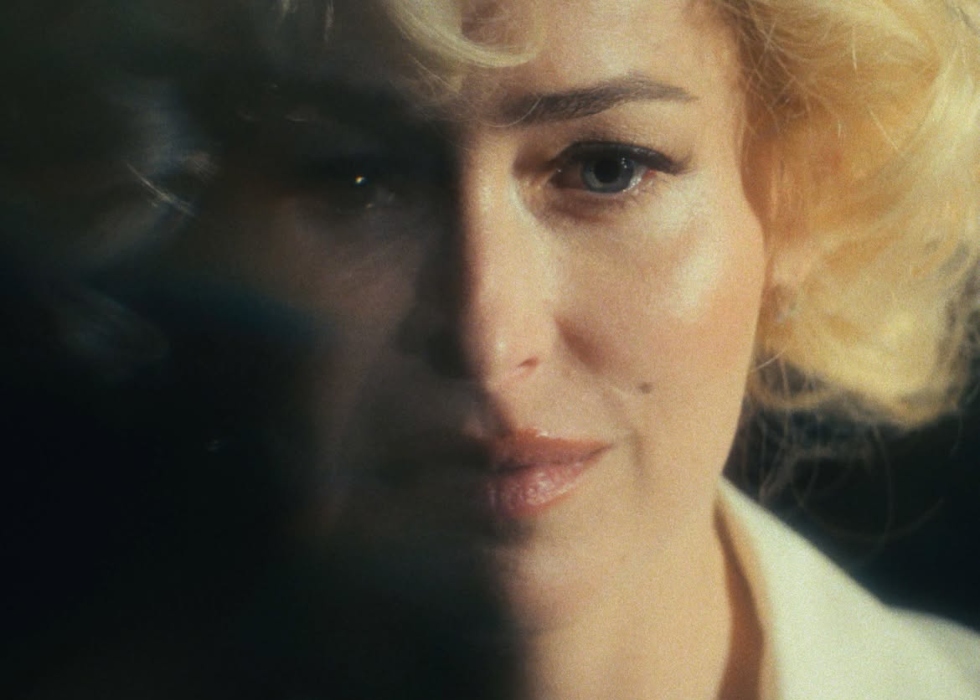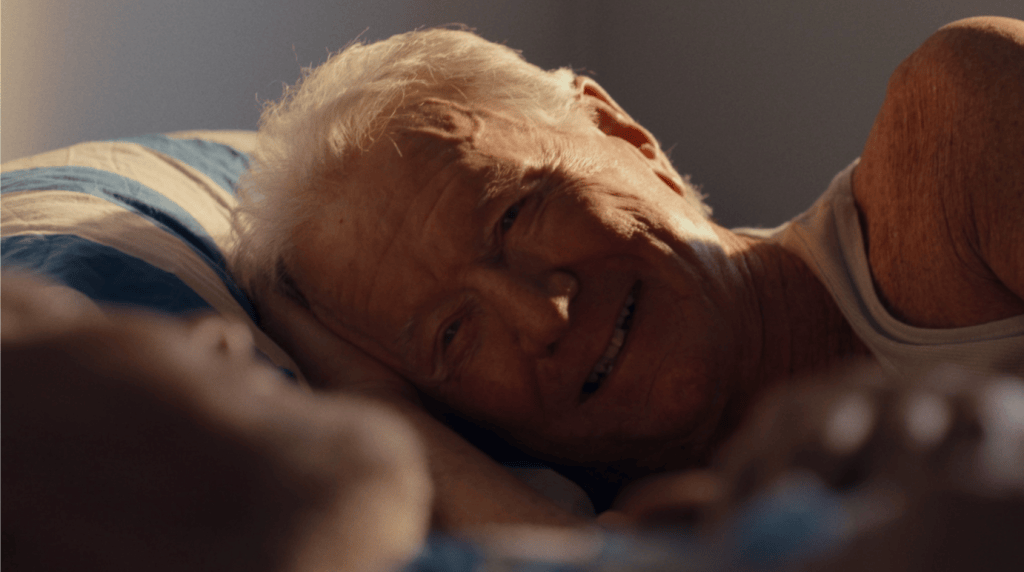
Julie Agnete Vang makes an assured and deeply affecting writing and directing debut with Oscar-qualified Danish short BLOOM, a beautifully observed story about grief, family and the truths we carry for too long.
There is something quietly devastating about BLOOM (Blomstring), the Oscar-qualified live-action short marking Danish actress Julie Agnete Vang’s debut as a writer-director.
Inspired by real events, the film begins in the aftermath of loss. Eighty-year-old Niels has recently lost his wife, but as his family attempts to navigate their grief, he reveals a secret he has kept buried for decades.
What follows is not simply a story about revelation, but about the emotional consequences of a life shaped by silence.
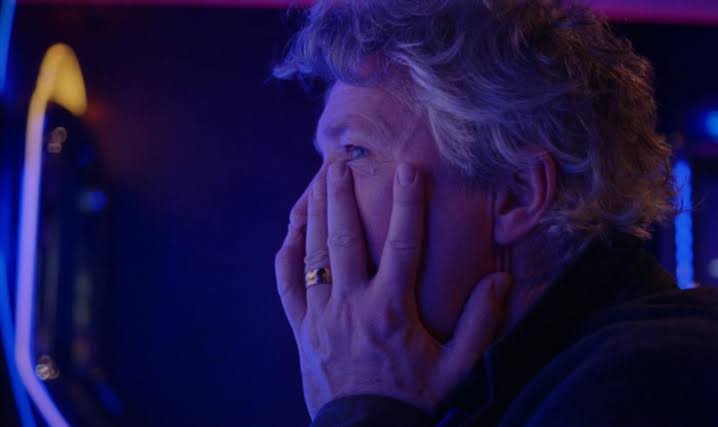
Veteran Danish actor Finn Nielsen gives an extraordinarily tender performance as Niels. With a career spanning more than six decades, Nielsen brings a lifetime of experience to a role that depends as much on what remains unspoken as what is finally said.
His performance is understated and deeply human. Niels is neither presented as a victim nor absolved of the choices he has made. Instead, Vang allows him to exist somewhere much more interesting: between regret and relief, fear and hope, selfishness and vulnerability.
That complexity is one of BLOOM’s greatest strengths.
At the heart of the film is a painful question: what happens when telling your truth finally gives you freedom, but causes someone else’s world to collapse?
For Niels’ daughter, the revelation does not arrive in isolation. It comes while she is already grieving her mother, forcing her to reconsider not only her father but the marriage and family history she believed she understood.
The resulting anger feels entirely justified, and BLOOM wisely refuses to turn the situation into an easy confrontation between right and wrong.
Instead, Vang is interested in the emotional wreckage between generations — the years lost, the opportunities missed and the damage created when people feel unable to live openly.
There is tragedy here, but also a streak of gentle humour that prevents the film from becoming overly sentimental. That tragicomic balance gives BLOOM warmth and makes its characters feel lived-in rather than constructed around a message.
The ensemble is exceptionally strong.
Nielsen is surrounded by some of Denmark’s most accomplished performers, including Hans Henrik Clemensen, Christine Gjerulff and Thomas Voss, and the depth of experience across the cast is evident. Even the smallest exchanges carry weight.
Gjerulff brings particular emotional force to the family dynamic, while Clemensen and Voss contribute to a world that feels as though it existed long before the camera arrived.
For Vang, who has spent much of her career in front of the camera in projects including Borgen, The Killing, The Commune and When the Dust Settles, the move into directing feels remarkably natural.
There is an actor’s sensitivity in the way she approaches performance. She trusts pauses. She allows expressions to linger. She understands that emotional revelation does not always arrive through dramatic speeches.
Some of BLOOM’s most affecting moments come precisely because Vang resists explaining them.
That restraint is particularly impressive for a first film.
A lesser version of this story might have pushed too aggressively towards catharsis. BLOOM instead understands that decades of secrecy cannot be resolved in a single conversation.
Love, grief, resentment and forgiveness sit alongside one another, often within the same moment.
The film’s title proves beautifully chosen.
Blooming suggests emergence, but also lateness — something finally coming into the light after remaining dormant for years. There is hope in that idea, but also melancholy. Some things can still grow, even after decades, but time cannot simply be recovered.
Produced by Hanne Bruun for M&M Productions, with Oscar-winning producer Kim Magnusson as executive producer, BLOOM has already screened at festivals including Nordisk Panorama and the Evolution Mallorca International Film Festival.
Its Oscar qualification feels particularly fitting for a film that demonstrates how much emotional territory can be explored within the short-film form.
Rather than attempting to tell an enormous story, Vang concentrates on one family, one revelation and the ripple effect it creates.
The result feels far larger than its running time.
Tender, beautifully performed and emotionally intelligent, BLOOM is an impressive debut from a filmmaker who clearly understands the power of restraint.
It is ultimately a film about the cost of hiding who we are — but perhaps more importantly, about whether it is ever truly too late to be seen.
★★★★★
BLOOM is Oscar®-qualified for consideration in the Live Action Short Film category.