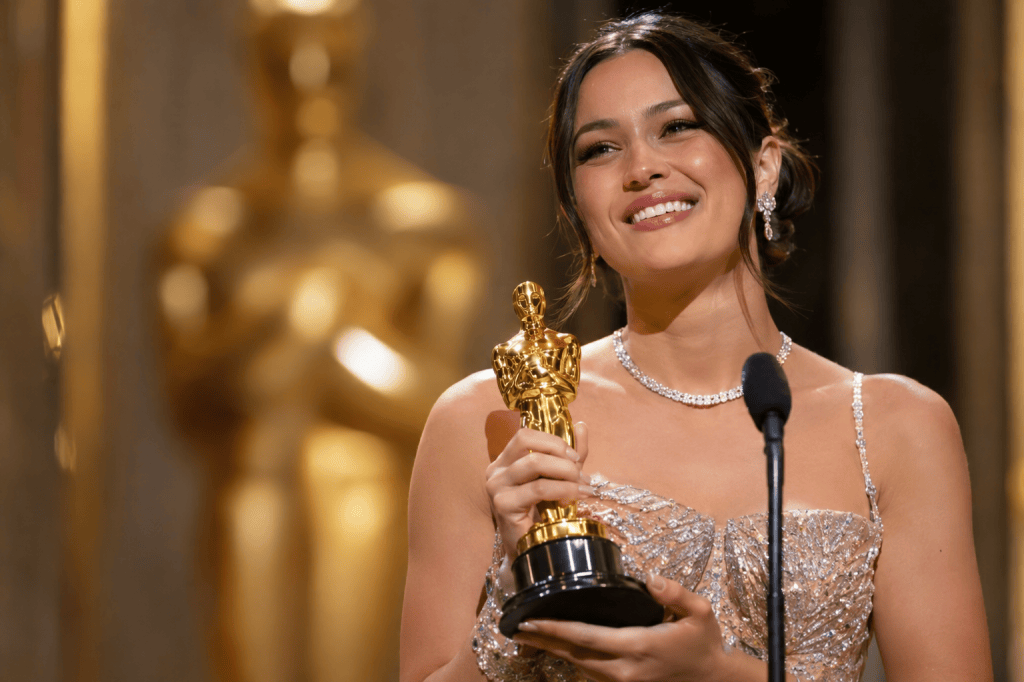
For almost a century, the Academy Awards have represented Hollywood’s most famous symbol of achievement. Yet for much of Oscar history, women were far more likely to be celebrated in front of the camera than given the same recognition behind it.
That is slowly changing.
From actresses who shattered racial barriers to directors who finally broke through one of Hollywood’s most stubborn glass ceilings, women have repeatedly transformed what an Oscar victory can represent. Their wins have not simply been career milestones; in many cases, they have opened doors for generations of women who followed.
At The Female Perspective, we look back at some of the women whose Academy Award victories changed cinema history.
Hattie McDaniel: The Woman Who Broke the First Barrier
In 1940, Hattie McDaniel became the first Black person ever to be nominated for — and win — an Academy Award, receiving Best Supporting Actress for Gone with the Wind.
It was a historic achievement made against an extraordinary backdrop of discrimination. The Oscars ceremony was held at the segregated Cocoanut Grove nightclub in Los Angeles, where McDaniel and her guest were seated separately from the film’s other nominees.
Her victory nevertheless became a landmark moment in Hollywood history. More than eight decades later, McDaniel’s name remains inseparable from the story of representation at the Academy Awards.
Katharine Hepburn: The Oscar Record Holder
Few actors have dominated the Academy Awards quite like Katharine Hepburn.
Across a career that stretched for more than six decades, Hepburn won four Academy Awards for Best Actress — for Morning Glory, Guess Who’s Coming to Dinner, The Lion in Winter and On Golden Pond.
Her four acting wins remain an extraordinary benchmark and helped establish her as one of cinema’s most enduring female icons.
What makes Hepburn’s legacy particularly powerful is that she built her career around women who were frequently intelligent, independent, complicated and unwilling to conform — qualities that mirrored her own famously individualistic public persona.
Sophia Loren: Proving Great Performances Have No Language Barrier
When Sophia Loren won Best Actress for Two Women, she became the first performer to win an Academy Award for a foreign-language performance.
The Italian star’s 1961 victory helped prove that the emotional power of a performance could transcend language and geography.
Loren’s portrayal of a mother attempting to protect her daughter during wartime remains one of the defining performances of her career, while her victory marked an important step towards the increasingly international Academy we recognise today.
Barbra Streisand: Winning in More Than One Arena
Barbra Streisand has never been easily confined to a single creative category.
She won her first Academy Award for Best Actress for Funny Girl, sharing the award with Katharine Hepburn in one of Oscar history’s rare ties.
But Streisand made another piece of history when she won Best Original Song for “Evergreen” from A Star Is Born. The victory made her the first woman to receive an Academy Award for composing music.
Streisand would go on to write, produce, direct and star in Yentl, becoming the first woman in Hollywood history to perform all four roles on a major studio film.
Her career demonstrated that a woman did not need to remain in the lane Hollywood initially created for her.
Halle Berry: A Historic Best Actress Victory
One of the most emotional Oscar moments came in 2002 when Halle Berry won Best Actress for Monster’s Ball.
Berry became the first Black woman to win the Academy Award for Best Actress.
Standing onstage, visibly overwhelmed by what the moment represented, her victory became much larger than a single performance. It acknowledged generations of Black actresses who had worked in an industry where leading roles and major awards had historically been difficult to access.
More than two decades later, Berry’s victory remains a defining moment in Academy Awards history.
Kathryn Bigelow: Finally Breaking the Best Director Ceiling
For decades, directing remained one of the Academy’s most male-dominated categories.
Then came Kathryn Bigelow.
At the 2010 Oscars, Bigelow won Best Director for The Hurt Locker, becoming the first woman in Academy Awards history to receive the directing prize.
The film also won Best Picture.
It was an extraordinary milestone — but perhaps equally revealing was how long it had taken. The Academy Awards had already existed for more than 80 years before a woman was finally named Best Director.
Bigelow’s victory changed what was possible.
Chloé Zhao: Making History Again
More than a decade after Bigelow’s breakthrough, Chloé Zhao won Best Director for Nomadland.
Her victory made Zhao the second woman to win the category and the first woman of colour to do so.
Nomadland went on to win Best Picture, while Frances McDormand won Best Actress.
Zhao’s intimate, naturalistic filmmaking style offered another reminder that there is no single definition of what an “Oscar film” — or an Oscar-winning director — needs to look like.
Her continued presence at the Academy Awards has also been significant. Zhao returned to the Best Director category as a nominee for Hamnet at the 98th Academy Awards in 2026.
Jane Campion: From Historic Nomination to Historic Win
Before Bigelow or Zhao won Best Director, Jane Campion had already helped dismantle barriers.
Campion became only the second woman ever nominated for Best Director when The Piano competed at the 1994 Academy Awards.
Almost three decades later, she returned to the category with The Power of the Dog — and won.
Her journey illustrates both progress and the frustratingly slow pace of change: one of world cinema’s most acclaimed filmmakers had to wait decades between her first Best Director nomination and her eventual victory.
Ruth E. Carter: Changing How Hollywood Sees Costume Design
Oscar history is not only written by actors and directors.
Costume designer Ruth E. Carter has spent decades using clothing to build characters, cultures and entire cinematic worlds.
After nominations for Malcolm X and Amistad, Carter won the Academy Award for Costume Design for Black Panther. She won again for Black Panther: Wakanda Forever, making her a two-time Oscar winner.
Her work has helped place African and African-American design traditions at the centre of some of contemporary cinema’s biggest films.
The Academy’s official database records Carter’s remarkable run of nominations across more than three decades.
Mikey Madison, Zoe Saldaña and a New Generation of Winners
The list of women shaping Oscar history continues to grow.
At the 2025 Academy Awards, Mikey Madison won Best Actress for Anora, while Zoe Saldaña took Best Supporting Actress for Emilia Pérez.
At the 98th Academy Awards in March 2026, Jessie Buckley won Best Actress for Hamnet, while Amy Madigan won Best Supporting Actress for Weapons. Women also triumphed across numerous technical and creative categories, including cinematography, casting, costume design and production design.
That matters because women’s success at the Oscars should never be measured only by the two categories carrying the word “Actress”.
Women are cinematographers, directors, producers, editors, designers, composers, writers and craftspeople whose work shapes every frame we see.
The Work Isn’t Finished
Oscar history contains extraordinary female achievement, but it also reveals how long women have sometimes had to wait for recognition.
Italian filmmaker Lina Wertmüller became the first woman ever nominated for Best Director in 1976 for Seven Beauties. More than three decades passed before Kathryn Bigelow finally became the first woman to win the award.
That gap tells its own story.
Progress cannot simply mean occasionally allowing exceptional women into spaces historically dominated by men. The goal must be creating an industry where female directors, writers, cinematographers, producers and technicians are no longer treated as exceptions at all.
The Oscars are certainly not the only measure of artistic achievement. Brilliant women have made important films without ever holding a gold statuette.
But awards shape careers. They generate financing, international attention and creative opportunities. They influence which filmmakers are trusted with the next major project and whose stories studios believe audiences want to see.
That is why representation among winners still matters.
The Female Perspective
Perhaps the greatest legacy of Oscar-winning women is not the statuettes themselves.
It is the doors they leave open behind them.
Hattie McDaniel, Sophia Loren, Barbra Streisand, Halle Berry, Kathryn Bigelow, Jane Campion, Chloé Zhao, Ruth E. Carter and countless others have each expanded Hollywood’s definition of who can stand on that stage.
Every first makes the next woman slightly less unusual.
And ultimately, that may be the real measure of progress: reaching the moment when a woman winning cinema’s highest honours is no longer regarded as history-making.
It is simply expected.